Federal Updates
Federal Budget Looming...?
With FY26 coming around the corner on October first, Congress is working through dual proposals to fund the Federal Government. This comes following the President's proposal from the spring in the backdrop of negotiations.
In August, the Senate Appropriations Committee released their proposal for Labor, Health & Human Services Appropriations legislation. The funding levels in the Senate version are mainly in line with Fiscal Year 2024 and 2025 funding, albeit with a slight decrease in the Adult formula.
Contained in the Senate proposal, additional requirements are placed upon The U.S. Dept of Labor (USDOL) and the Employment and Training Administration (ETA). These new requirements include:
- Improving access to social service benefits such as SNAP, TANF and tax credits.
- Encouraging USDOL to work with state governments to increase skills-based hiring, credential completion, and competency-based education.
- Encouraging USDOL to work with state governments to create a long-term strategy for online training service delivery.
- Requires USDOL to work with other federal agencies to pursue workforce data linkages and report back to Congress.
- Promote technology usage for jobseekers such as digital skills and online interview preparations.
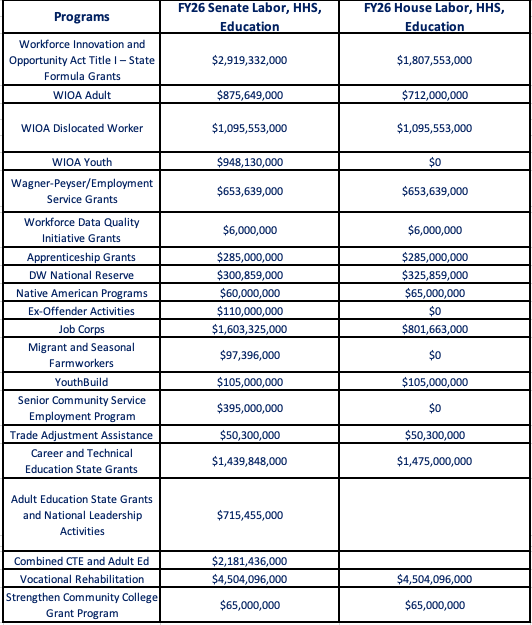
On the other side of Congress, the House Appropriations Committee released their proposal for Labor, Health & Human Services Appropriations legislation which was far more grim than the Senate version. The House proposal would gut WIOA funding by cutting Adult allocations and eliminate the Youth program altogether. It would also eliminate programs like the Senior Community Service Employment Program, Adult Education and other national items like the Migrant Seasonal Farm Worker Program and Ex-Offender activities.
The House proposal would create a 'gap year' for Adult funding. Typically, WIOA Title I is funded through 'advance appropriations' meaning that the funding for Program Year 2025 is already funded under current law.
However, this House proposal would rescind that $712 million advance appropriation, scheduled for Oct 1, 2025, and instead include $712 million to be available on October 1, 2026. That creates the 'elimination' of the Adult program for PY2025.
Further, the House proposal included a “consolidated block grant” which would allow states to apply to USDOL that would allocate consolidated funding to states to carry out WIOA programs and activities. This proposal could be seen as an alternative to the block grant proposal contained in the President’s proposal which called for complete deconstruction of WIOA funding and called for block grants for every state.
Neither proposal has been voted on by their respective branch, as significant disagreement remains between the House and Senate proposals. This would indicate that instead of a full fiscal year budget, we could again see a “Continuing Resolution” (CR) to fund the government for a short-term period. The House Appropriations Committee has released a CR bill to keep the government funded and open until November 21, 2025 – an effort to buy more time for negotiating a longer-term spending bill.
Below please find a chart representing the differences in funding between the Senate & House Proposal.
| 





.gif)